

Student Engagement Increased Following Phone-Free Policy
Friday, September 4, 2026
by Dr. Ellie Shockley
House Bill 1160 – an act to create and enact a new section to chapter 15.1-07 of the North Dakota Century Code, relating to the use of personal electronic devices during school instructional time – was passed by the 2025 North Dakota Legislative Assembly, signed into law by Gov. Kelly Armstrong, and became effective August 1, 2025.
Referred to as a “bell-to-bell” phone-free schools policy, the law requires public school students’ personal electronic communication devices be stowed and inaccessible from the start of the school day until dismissal. Describing the intent of the bill, Gov. Armstrong explained: “This is a game changer for our public schools, giving students the freedom to focus on learning and to interact with teachers and friends without the constant tug of their cell phones and addictive social media.”
This policy change coincides with a new North Dakota Student Engagement Survey (NDSES) used in the North Dakota Department of Public Instruction’s accountability framework for public schools. This NDSES newly captures school belonging, which reflects a student’s sense of social inclusion or exclusion at school. The survey also captures student engagement that has been previously measured for accountability, namely, behavioral engagement, cognitive engagement, and emotional engagement. Behavioral engagement refers to attendance, positive conduct, work habits, and participation in class and school activities. Cognitive engagement refers to the cognitive processing a student brings to academic tasks, the amount and type of strategies a student uses, and the extent to which a student connects their learning across contexts. Emotional engagement refers to students’ feelings about school, learning, teachers, and peers.
While the new NDSES was administered in February 2026 – months after the phone-free schools policy effective date – three districts in very different locales had participated in a pilot study of the new NDSES in February-March 2025. For these districts, many students had self-reported engagement and belonging both before and after the phone-free policy. Of particular interest were high school students, as elementary and middle school students generally did not have access to their phones at school during the pre-policy period while high school students did. Thus, high school students experienced the greatest change to their learning environment following the phone-free policy. A focus on these students enabled me to test the hypothesis that the policy improved student engagement and school belonging.
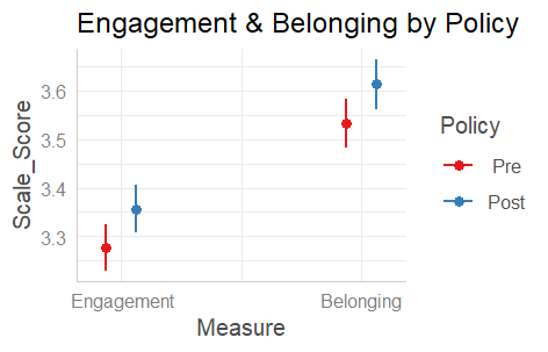
Students included in analyses (N = 1,036) met the following criteria: They completed the engagement and belonging questionnaire in both the 2025 pilot study and the 2026 statewide administration and, at both time points, were not enrolled in a virtual school, remained within the same school district, and were in enrolled in high school (grades 9-12).
Using mixed linear modeling packages for statistical computing in R, I fit models predicting engagement and belonging scale scores (ranging from 1 to 5). Models revealed that the phone-free schools policy coincided with a statistically significant increase overall in both engagement and belonging. One exception to the trend was that there was no positive effect of the policy on belonging in the fringe rural district. Belonging was highest in this district across both time periods, suggesting the impact of the policy on belonging might be limited in smaller communities with already high student belonging.
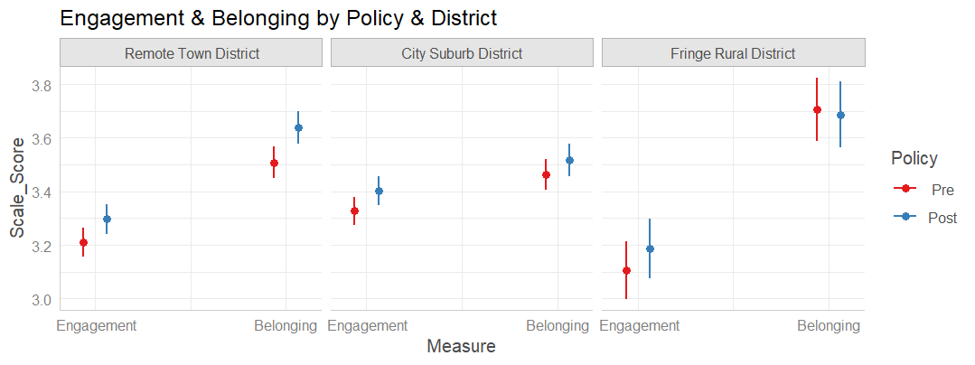
Altogether, the phone-free policy generally coincided with students’ self-reported improvements in engagement and belonging. However, the analyses have limitations. Because the policy was enacted for the 2025-2026 school year rather than, say, the 2026-2027 school year, pre-policy data is only available for the three districts that participated in the 2025 survey. Additionally, because the policy was simultaneously enacted statewide, it is not possible to conduct a strong analysis for causal inferences. Ideally, the policy would have been enacted in some rather than all districts for the first year. This would allow us to determine if engagement and belonging similarly increased in districts without a phone-free policy, shedding light on potential alternative explanations. Lacking such analyses, we can say that engagement and belonging increased following the phone-free policy, but we cannot precisely say why.
If the phone-free policy is what caused increased student engagement and belonging, the effect was small. However, that is not surprising, as the first year of an intervention in our complex social world is unlikely to yield strong effects. Despite the small effect size, the statewide implementation of HB 1160 suggests that this shift may have improved engagement and belonging of tens of thousands of North Dakota public high school students in a manner of months. A relatively low-cost intervention impacting many students does not require a large effect size to be considered worthwhile.
Dr. Ellie Shockley is an Educational Data Warehouse Specialist on the NDUS institutional researcher team. In this capacity, she also works closely with the Department of Public Instruction (PK-12) and the Information Technology Department. She often responds to education data requests that come from state agencies or from outside of state government. Her work ranges from pulling raw data and sharing it according to our best practices, to conducting complex statistical analyses in order to answer research questions, to assisting with inter-agency collaborations related to education data, and more.